Faculty: Hsing-Yi Cho Assistant Professor

| Name | Hsing-Yi Cho |
|---|---|
| Title | Assistant Professor |
| Telephone | +886-6-2757575 ext. 58312 |
| 11508010@gs.ncku.edu.tw | |
| Research Expertise | Molecular Biology, Plant Physiology, Functional Genomics |
 Education
2009 – 2016 Doctorate, Molecular and Biological Agricultural Sciences, International Doctoral Program, Academia Sinica, Taiwan / Graduate Institute of Biotechnology, National Chung Hsing University
2005 – 2007 Master, Biological Sciences, National Sun Yat-Sen University
Research History
- 2026.08 – present
Assistant Professor, Institute of Tropical Plant Sciences and Microbiology, National Cheng Kung University - 2020.09 – 2026.07
Postdoctoral Researcher, Department of Genetics, Harvard Medical School / Department of Molecular Biology, Massachusetts General Hospital, USA - 2016.08 – 2020.08
Postdoctoral Researcher, Agricultural Biotechnology Research Center, Academia Sinica
Introduction of Laboratory
Climate change is making extreme rainfall increasingly frequent, and nowhere more so than in tropical and subtropical regions. Heavy rain is no longer confined to the rainy season, and unpredictable flooding of farmland has become a major threat to global food production.
We study a deceptively simple question: how do plants anticipate hypoxia upon flooding/submergence, and switch on protection before the damage is done?
Our lab combines functional genomics, proteomics, and live-cell calcium imaging to dissect how plants sense and adapt to submergence-induced hypoxia, with the long-term goal of identifying molecular targets for stress-resilient crops.
Research Aims
Life began in a world without oxygen. Only after photosynthesis raised atmospheric O₂ did cells stake their energy metabolism on it — a leap in efficiency, and a commitment with no way back.
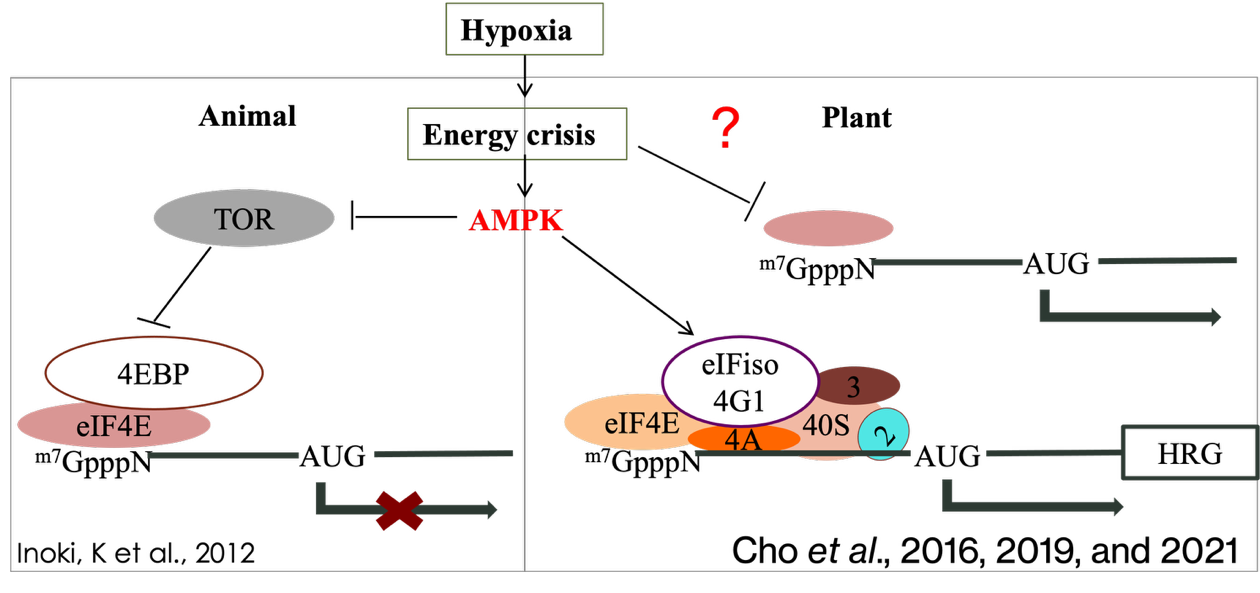
Both animal and plant cells shut down protein translation to conserve energy until oxygen is restored. In animals, this is well understood; one of the pathways is inhibition of TOR (Target of Rapamycin) activity, which suppresses translation. In plants, how this control is executed remains largely unresolved.
1. Ethylene Control of the Hypoxia Response
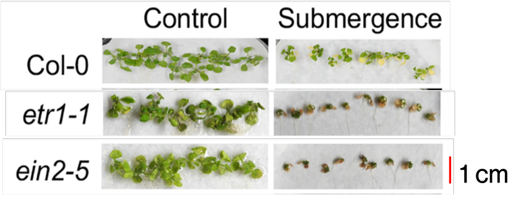
Ethylene is the only gaseous plant hormone, and it plays a central role during flooding. Beyond activating stress-responsive transcription factors, it directly shapes protein translation: acting through EIN2 (Ethylene Insensitive 2), and working together with GCN2 (General Control Nonderepressible 2) to suppress translation.
The most striking finding: within 15 minutes of submergence (before oxygen in the surrounding water has measurably declined), ethylene has already triggered the hypoxia response and suppressed translation, suggesting that plants do not wait for hypoxia — they anticipate it.
Open question: How does ethylene signaling activate GCN2? We are using proteomic and functional genomic approaches to trace the full path from gas perception to translational reprogramming.

2. Calcium Signaling and Its Crosstalk with Ethylene
Calcium is a universal second messenger. Different growth conditions and stresses trigger distinct organelles to release Ca²⁺, each activating its own downstream response. Hypoxia is known to elicit an unusually strong calcium signal, but which organelle initiates it, and how that signal is decoded, remain unclear.
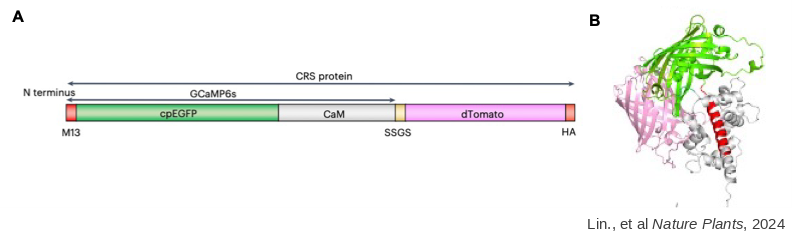
We apply a newly developed ratiometric calcium sensor system, CRS (Ca²⁺ Ratiometric Sensors), to map organelle-specific Ca²⁺ dynamics during submergence. Our aims: identify the primary sensing mechanism operating in the earliest phase of stress; and determine how calcium signaling intersects with ethylene signaling to drive hypoxia adaptation.
3. The Dual Role of TOR in Stress Adaptation
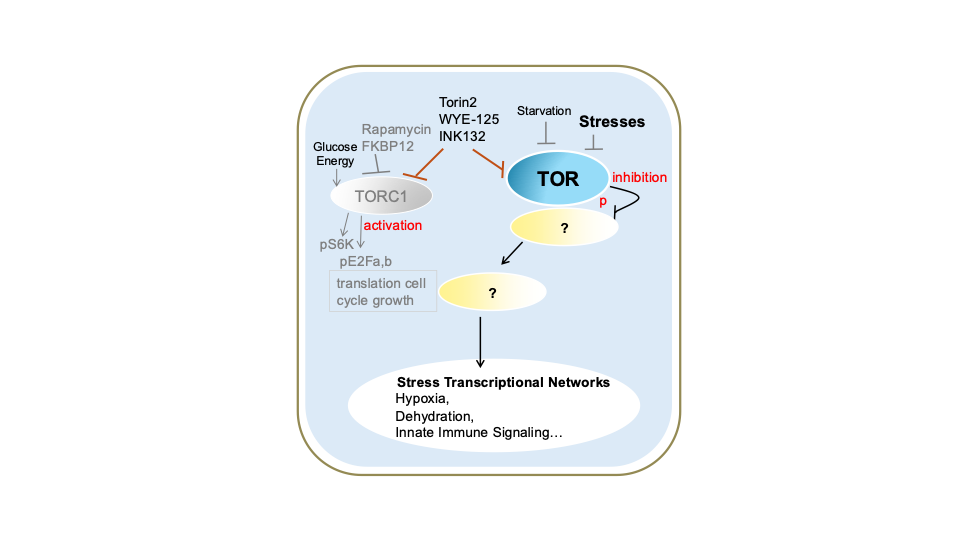
TOR is a central hub coordinating growth and stress adaptation. However, its role is not straightforward. Large-scale transcriptome analyses reveal an apparent paradox: inhibiting TOR activates broad sets of abiotic stress and defense-related genes, whereas enhancing TOR activity before stress onset improves stress tolerance. TOR therefore acts less as a simple switch than as a context- and timing-dependent regulator.
Open question: How do the level and timing of TOR activity govern the trade-off between growth and defense? We combine functional genomics with genetics and molecular biology to map this regulatory network.
Join Us
We welcome students interested in plant signaling, functional genomics and transcriptomics, proteomics, or live-cell imaging.